Third Sunday of Advent
by Fr. Thomas Kagumisa | 12/11/2025 | Weekly Reflection"Are you the one who is to come, or should we wait for another?" (Matthew 11:3)
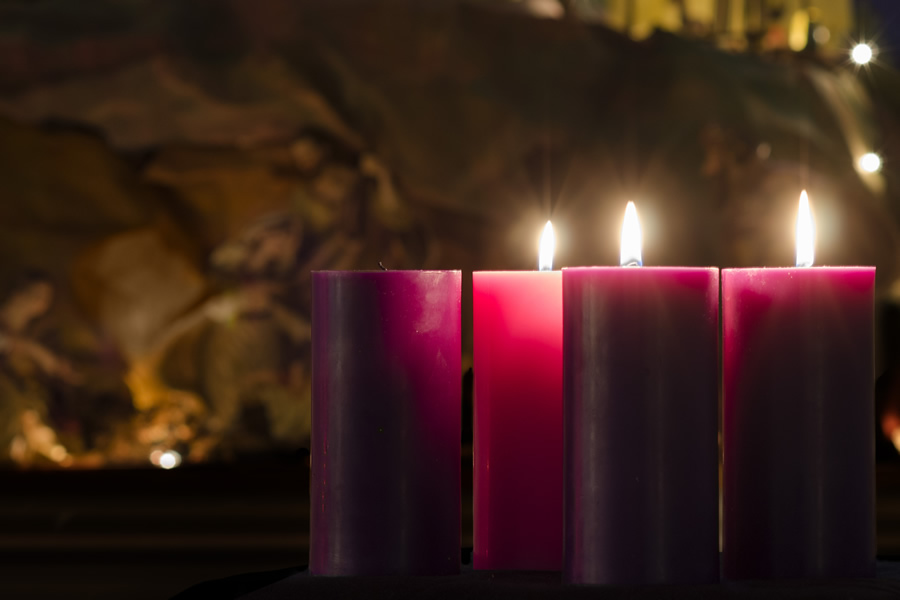
Today is known as "Gaudete" Sunday, and the Mass begins with the opening antiphon, "Gaudete in Domino semper" ("Rejoice in the Lord always"). Correspondingly, the entire Liturgy invites us to rejoice; we also light the rose candle of the Advent wreath, and the priest wears rose vestments-all to express our communal joy in the coming of Jesus as our Savior.
While Advent is a season for examining our lives, renewing our faith and hope, turning back to God, and practicing charity and repentance, today we are invited to rejoice as a foretaste of the joy of Christmas that is near. In fact, Advent is also a time of joy, as the expectation of the Lord's coming awakens in the hearts of believers. Looking forward to someone's arrival is always a reason for joy.
This joyful aspect is present in the first reading of today's Mass. Isaiah proclaims, "The desert will rejoice, and flowers will bloom in the wastelands. Those whom the Lord has rescued will travel home by that road. They will reach Jerusalem with gladness." Isaiah delivered this message at a time when Israel was suffering in Babylonian captivity, proclaiming a new world of peace, justice, and sheer joy.
To all of us, this message is a reminder that we must never succumb to despair. God can transform our deserts into gardens. What may seem impossible to others is possible with God. When we hear about a family with a troubled reputation or a person living a life of vice, we might think: "This desert can never become a garden!" Some may believe they are too sinful to be loved or forgiven by God, but Isaiah urges us to discard such thinking.
Similarly, the Gospel reading today amplifies the message of Christmas joy that we are invited to anticipate. We read that "when John heard in prison what the Messiah was doing, he sent a message by his disciples and asked Him, 'Are you the one who is to come, or should we wait for another?" This question doesn't indicate that John doubted the Messiah's identity. He had baptized Jesus in the Jordan and had heard God the Father affirm Him: "This is my beloved Son, with whom I am well pleased; listen to him" (Mark 1:11). John knew Jesus was the Messiah, but he was concerned that his disciples might not fully understand this. As he faced his death in prison, he didn't want to leave them uncertain. He sent them to Jesus to discover for themselves if He was indeed the awaited Messiah. It was as if he was saying, "If you doubt who Jesus is, go and see what He is doing, and your doubts will be resolved."
Jesus's answer was straightforward: "Go and tell John what you hear and see: the blind regain their sight, the lame walk, lepers are cleansed, the deaf hear, the dead are raised, and the poor have the good news proclaimed to them." He references what Isaiah (61:1) had prophesied about Him. These are the signs that any good Jewish person who was expecting the Messiah was watching for! Essentially, Jesus is saying, "If you see me doing this, know that the Messiah is in your midst. I am He! The Kingdom of God is at hand!"
This is a message of sheer joy, and for that reason, we are invited to rejoice. The Savior who will be born for us is coming to seek those who are lost in sin and to bring them back to God (Luke 9:10). He does not take pleasure in the death of the wicked (Ezekiel 18:23). He comes to redeem us from slavery to sin, to deliver us from every kind of evil, to protect us from temptations, to wash away our sins through the sacraments of healing, and to nourish us through the Eucharistic meal.
Just as ancient Israel longed for Messianic deliverance from Babylonian exile and Roman rule, all of humanity longs in joyful hope for the Messiah to fully redeem them from spiritual captivity. Therefore, at this moment of the Advent season, the words of the following hymn ring especially true: "Rejoice, rejoice, Emmanuel shall come to you, O Israel!"
Let us open our hearts to receive Him.
Yours in Christ, the King who is to come,
Fr. Thomas Kagumisa